
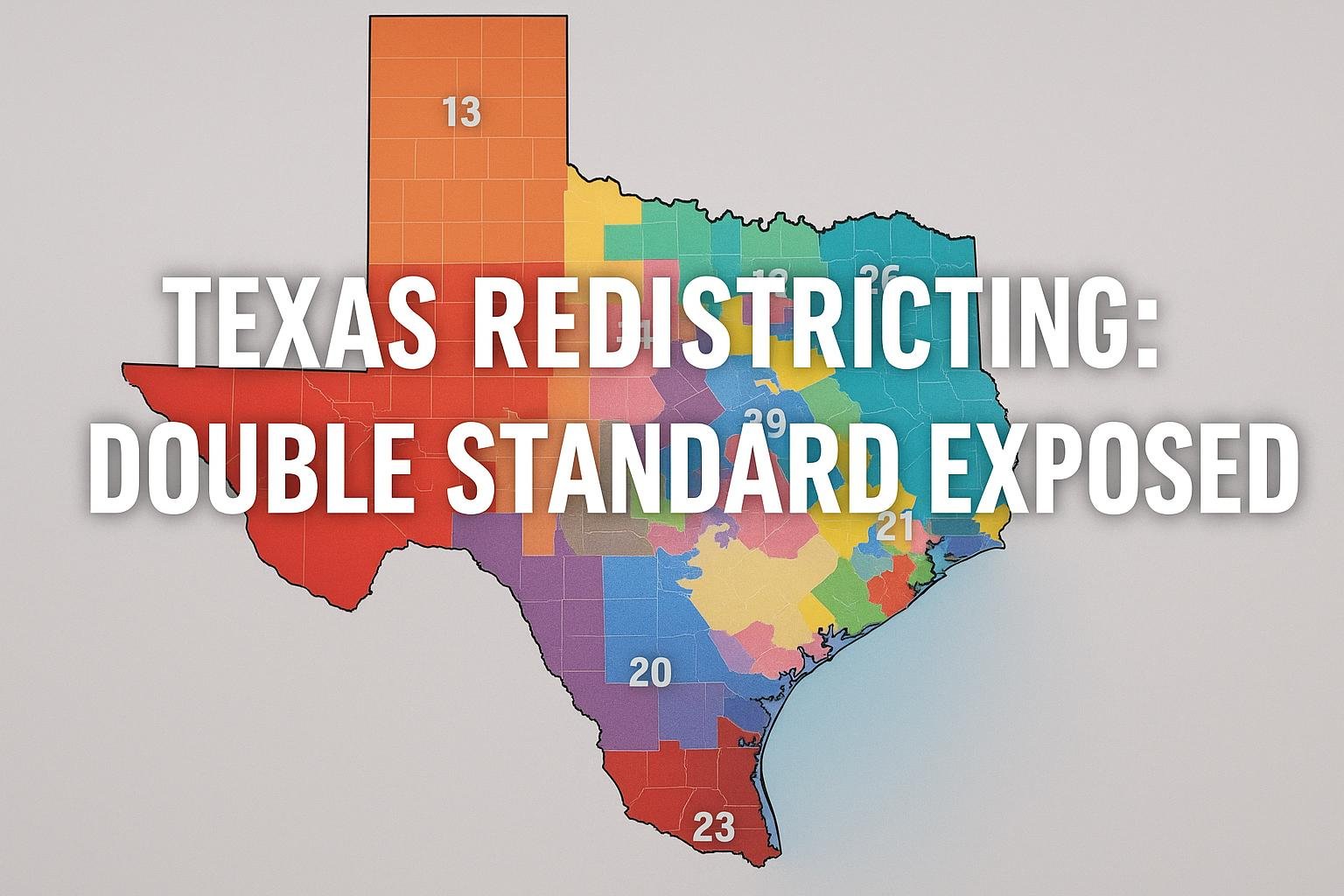
Map of Texas showing newly proposed 2025 congressional districts amid partisan redistricting battle.
On August 3, 2025, over fifty Democratic members of the Texas House of Representatives left the state to deny the chamber a quorum. Their goal: to block a vote on new congressional redistricting maps proposed by the Republican majority. By physically absenting themselves from legislative duties, they halted Texas redistricting efforts – a constitutional process central to representative governance.
Notably, this is not the first time Democrats have used these tactics in Texas. Similar walkouts occurred in 2003 and 2021. In each case, Democrats framed their departure as a stand for “voting rights” or “fairness.” However, in a constitutional republic, representation is governed not by slogans or theatrics, but by law, population shifts, and elected accountability.
But it’s part of a larger national pattern worth examining: when Democrats are out of power, they claim redistricting is rigged. When they control the process, they redraw the maps to lock in long-term advantages.
Redistricting in a Constitutional Republic
The United States is not a direct democracy—it is a constitutional republic. Every ten years, following the U.S. Census, states must redraw congressional districts to reflect population changes. This is not optional. It is a constitutional requirement under Article I, Section 2.
In Texas, the 2020 Census showed strong population growth, especially in suburban and exurban areas that lean Republican. As a result, the state gained two congressional seats. Republican lawmakers proposed new maps in 2025 to reflect those changes. While the new maps favored the GOP, they followed standard redistricting practice: leveraging majority control to produce politically favorable—but legally permissible—districts.
Importantly, in a constitutional republic like the United States, redistricting is not merely a bureaucratic exercise. It’s a central mechanism by which citizens’ voices are represented. While both parties have historically used redistricting to their advantage, recent cycles show an increasingly aggressive pattern by Democrats to redraw maps mid-decade when electoral outcomes don’t go their way.
That’s what makes the Texas walkout so significant—and so revealing.
Texas Redistricting: Growth, Representation, and Political Tactics
As noted, Texas gained two congressional seats after the 2020 census, due to major population growth—particularly in suburban and rural areas that tend to lean conservative. The Republican-led legislature introduced new maps in July 2025, aiming to reflect those shifts.
Democrats accused Republicans of drawing lines that diluted minority votes, while Republicans countered that the maps reflected legal population distribution and complied with the Voting Rights Act.
Rather than participate in debate or pursue legal remedies, Democratic legislators abandoned their duties as elected officials and left the state—temporarily halting legislative function. Governor Greg Abbott labeled the move a dereliction of duty. Legal challenges and political backlash are now unfolding.
Redistricting Double-Standard in Democrat-Controlled States
If Democrats oppose redistricting when out of power, how do they behave when they control the process? A look at three key states—New York, New Jersey, and Illinois—offers a clear picture:
New York Redistricting: When Democrats Lose, They Redraw the Rules
After the 2020 census, New York lost a congressional seat, dropping from 27 to 26. The state’s “Independent Redistricting Commission” failed to agree on a map, so Democrats in the legislature drew their own. It was so blatantly gerrymandered that the state’s highest court threw it out and had a neutral expert draw new lines.
That neutral map cost Democrats dearly in 2022: Republicans flipped four seats, giving the GOP a major boost in the House.
So what did Democrats do?
They changed the map again in 2024—this time through their allies in the commission and legislature—and won those same seats back.
Now Gov. Kathy Hochul is proposing a constitutional amendment to abolish independent redistricting altogether, so Democrats can redraw the maps whenever it benefits them.
The pattern is clear:
- 2022: Neutral court map → Democrats lose seats
- 2024: Democrat-drawn map → Democrats take them back
- 2025: Democrats push to rewrite the rules permanently
So while Democrats cry foul about redistricting in red states like Texas, they’re busy rewriting maps in blue states like New York to lock in power—mid-decade and without shame.
This isn’t democracy. This is a double-standard manipulation—and it’s happening in plain sight.
New Jersey Redistricting: Quiet Power, No Outrage
New Jersey’s redistricting didn’t make headlines—but it should have.
Unlike other states, New Jersey uses a 13-member commission to draw its congressional maps. It’s supposed to be balanced—6 Democrats, 6 Republicans, and 1 tie-breaking vote. But in 2021, that tie-breaking vote went to a Democrat, giving the left full control.
They used it.
In 2022, the new map:
- Protected all Democrat incumbents by redrawing district lines around them
- Removed conservative towns from swing districts
- Packed liberal strongholds together to ensure dominance
Only one seat flipped to Republicans (NJ-7)—and that was likely strategic. Democrats sacrificed it to make the rest of the map unbreakable.
Today, Democrats hold 9 of 12 seats—and that hasn’t changed since.
Notice What’s Missing?
There were no:
- Walkouts
- Protests
- Court challenges
- Accusations of gerrymandering
But now that Texas is exercising its constitutional right to do the same? There’s a national media firestorm.
New Jersey’s redistricting was surgical, partisan, and successful—and no one cared. Because when Democrats gerrymander, it’s “strategic.” When Republicans do it, it’s “authoritarian.”
Illinois Redistricting: One Seat Lost, All Power Preserved
After the 2020 census, Illinois lost a congressional seat—shrinking from 18 to 17 districts. That didn’t stop Democrats from tightening their grip.
They controlled the entire redistricting process: the legislature, the governor’s office, and the pen that drew the new lines.
Here’s what they did:
- Merged two Republican districts into one, forcing GOP incumbents to battle each other
- Carved out a brand-new Democrat-friendly seat (IL‑13) that flipped blue for the first time in over 100 years
- Redrew swing districts to dilute conservative votes and secure safe D seats across the map
The result? Democrats walked away with 13 of 17 seats, while Republicans were left with just 4.
And yet—no protests. No lawsuits that stuck. No cries of “gerrymandering” from CNN.
The Pattern Is Clear
- New York redrew their maps mid-decade after losing swing seats
- New Jersey used a “neutral commission” to lock in incumbents
- Illinois lost a seat but still redrew the board in their favor
Where’s the outrage?
When Democrats control the map, it’s strategy. When Republicans do, it’s scandal.
Texas Redistricting Media Coverage: One Playbook, Two Narratives
Across New York, New Jersey, and Illinois, Democrats drew the maps. They did it boldly, unapologetically, and without real opposition. The results?
- New York redrew the rules mid-decade after losing seats.
- New Jersey engineered “independent” maps that preserved power and minimized GOP threat.
- Illinois lost a seat—but redrew the board to lock in their dominance.
In all three states, the media’s response was muted at best:
🟦 CNN: “Democrats preserve gains through smart redistricting.”
🟦 MSNBC: “New York’s maps restore fairness after GOP advantage.”
🟦 The New York Times: “Commission-led map ensures representative balance.”
Now compare that to Texas:
When Republicans control the redistricting process in Texas, it’s not called “strategy.”
It’s called racism. voter suppression. authoritarianism. fascism.
Headlines from the media regarding the Texas redistricting:
🔴 “Texas GOP advances war on democracy” – MSNBC
🔴 “Republicans draw maps to entrench white power” – The Guardian
🔴 “Democracy dies in redistricting” – The Washington Post
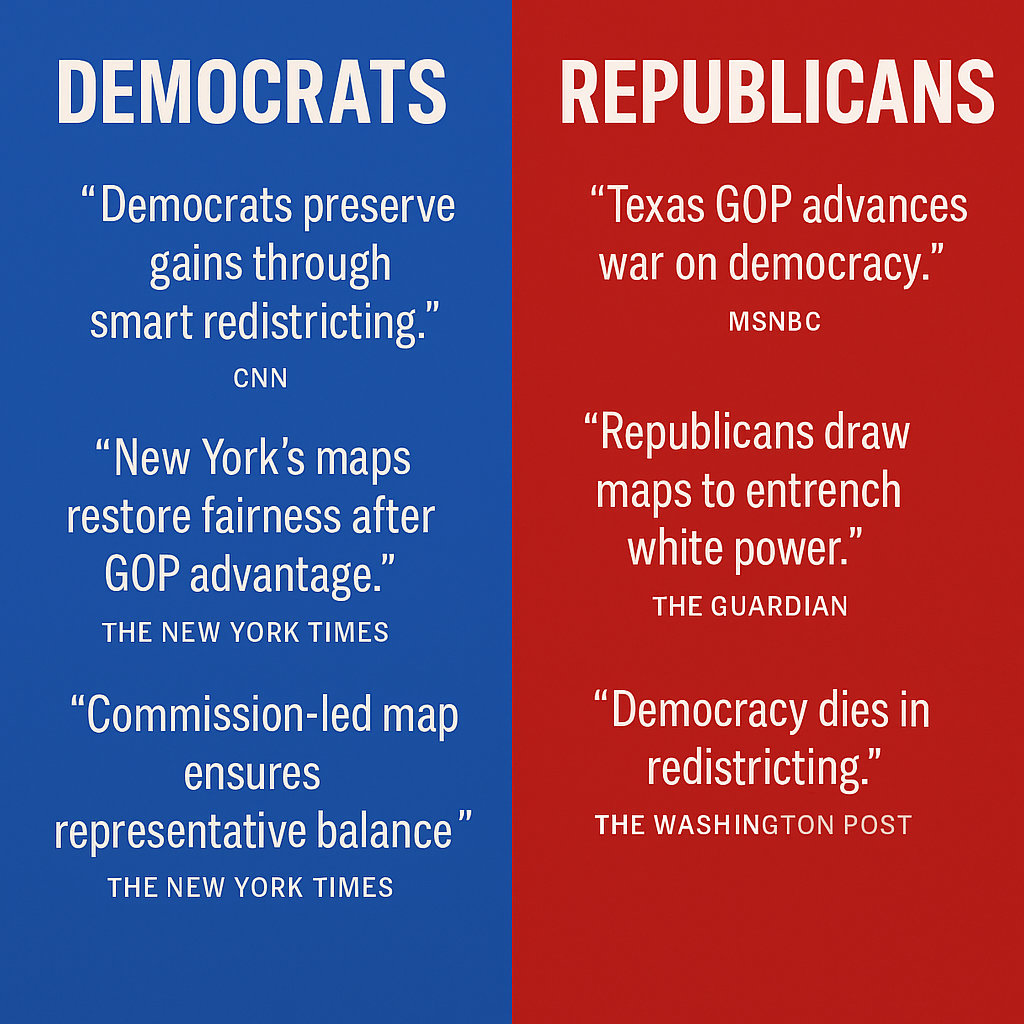
Even when Democrats fled the state to block a vote, they were praised as heroes.
Meanwhile, when Republicans redraw districts within the same legal framework used in Illinois or New Jersey, it becomes a constitutional crisis.
So let’s stop pretending this is about “saving democracy.” This is about preserving power, and the press is part of the machine.
The Truth of Texas Redistricting
The redistricting fight isn’t about fairness. It’s about power—and who’s allowed to use it without consequence. When Democrats draw maps in New York, New Jersey, and Illinois, it’s called strategy. When Republicans do it in Texas, it’s labeled an attack on democracy. The same legal process is cast as virtuous or villainous depending solely on which party controls the pen. Allies in the media cheer blue-state gerrymanders as “smart” and “fair,” while branding red-state efforts as racist and authoritarian—even when the outcomes follow census data and constitutional procedure.
The Texas walkout didn’t expose injustice—it exposed the left’s hypocrisy. Because when Democrats lose, they rewrite the rules. When they win, they rewrite the narrative. Either way, the system isn’t broken—it’s rigged. On purpose.
Sources
- New York Court tosses Democrat-drawn redistricting map: nycourts.gov, Washington Post
- Kathy Hochul’s redistricting amendment push: New York Post
- New Jersey redistricting and tie-breaker control: New Jersey Monitor
- Illinois post-census map manipulation: Wikipedia – Illinois congressional districts
- Texas Democrat walkout in 2025: My Journal Courier
- Media contrast in redistricting coverage: The Guardian


This really cleared things up for me.