
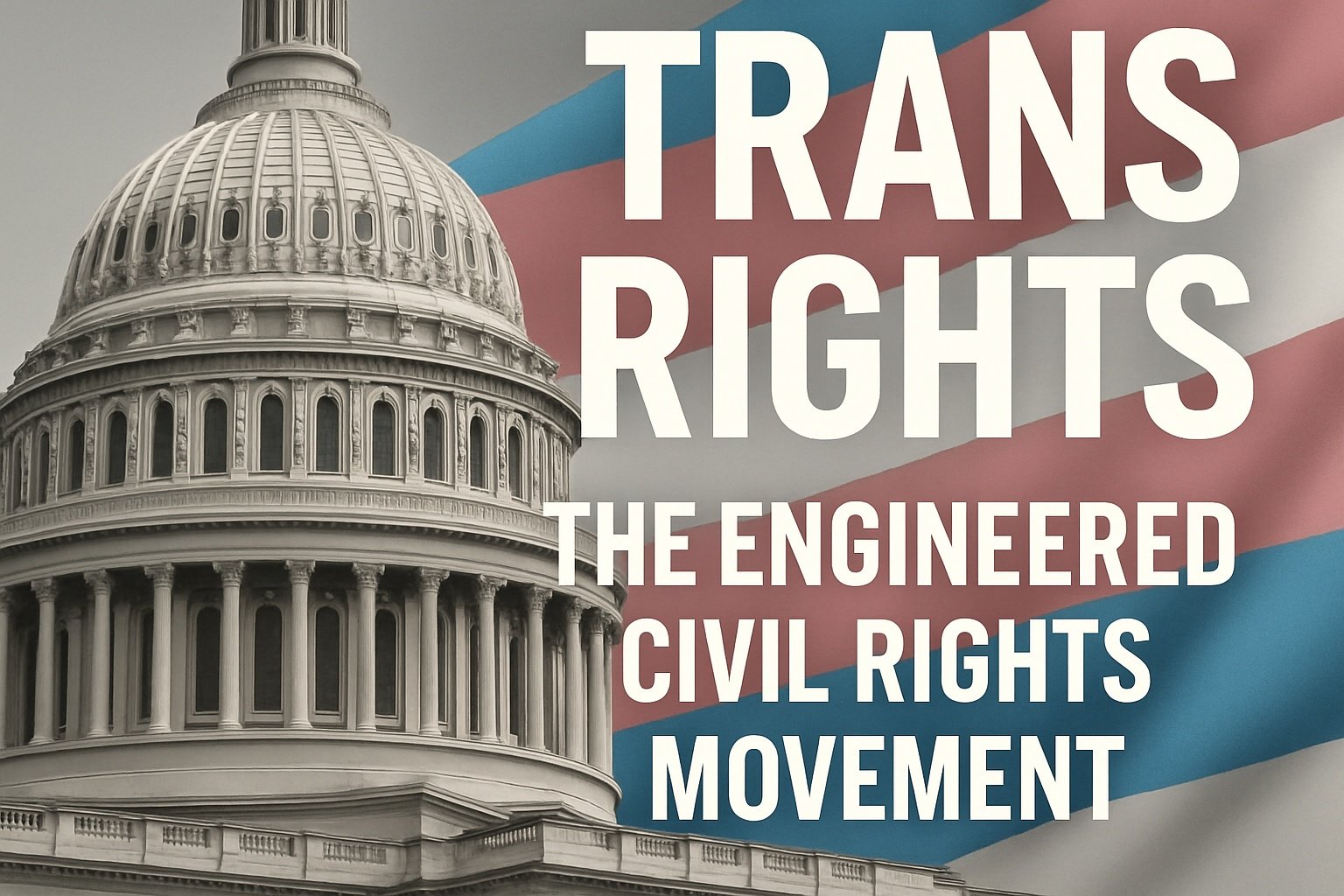
The U.S. Capitol stands behind the transgender pride flag as the movement’s political origins are clear.
In the span of just over a decade, what was once a niche academic discussion about gender identity has transformed into one of the most dominant cultural and political flashpoints in American life. From federal guidelines on pronouns in schools to corporate HR mandates on gender inclusivity, the trans rights movement has moved with stunning speed—far faster than any prior civil rights expansion in U.S. history.
But this cultural acceleration raises a critical question: Was the trans movement a bottom-up demand from a marginalized community seeking inclusion, or was it a top-down political initiative—strategically crafted, funded, and promoted by Democratic Party operatives and their media allies?
A closer look suggests the latter.
The Shift After Obergefell
In 2015, the U.S. Supreme Court’s decision in Obergefell v. Hodges legalized same-sex marriage nationwide. For progressive strategists, this landmark win created both a sense of finality—and a vacuum. The LGBTQ political infrastructure, from nonprofits to PACs, now faced an existential problem: What next?
According to leaked memos reported by Politico, the Human Rights Campaign (HRC) was already preparing to “expand its public-facing mission” to include transgender issues. That same year, the Obama administration issued sweeping federal guidance instructing public schools to allow transgender students to use bathrooms and locker rooms that align with their gender identity—a policy enacted through executive fiat rather than legislation.
This sudden shift came in contrast to public popularity. In fact, a 2016 Pew Research poll found that only 35% of Americans supported access to restrooms based on gender identity. Yet the issue was swiftly embedded in federal policy and broadcast as a moral imperative.
The Democratic Party’s Embrace of Trans Rights
By the 2020 election cycle, the Democratic Party platform included an explicit commitment to the “full inclusion of transgender and non-binary people.” President Joe Biden elevated trans rights as a defining cause of his administration, appointing the first openly transgender federal official and signing executive orders to enforce gender identity protections across nearly all federal agencies.
This wasn’t simply about inclusion. It was political calculus.
“The trans issue gives Democrats a cultural litmus test and a wedge they can use to portray opposition as bigotry,” said Dr. Wilfred Reilly, a political science professor and author of Hate Crime Hoax. “It’s not necessarily about supporting trans people—it’s about controlling the language and moral high ground.”
Media as Multipliers
The role of legacy media in advancing the trans narrative is clear. Prior to 2015, terms like cisgender, gender-affirming care, or non-binary were rare in national coverage. By 2020, they were normalized—often without public explanation or critical scrutiny.
Former MSNBC producer Ariana Pekary resigned in 2020, citing what she described as the network’s “ratings-driven framing” and narrative manipulation. “It’s not journalism—it’s narrative management,” she wrote.
The coordination between activists, journalists, and political figures created a feedback loop: emotionally charged stories, celebrity endorsements, and political demands amplified one another—often painting disagreement as dangerous or violent.
Funding the Trans Rights Narrative
The financial engine that powers the trans movement is rooted in Democratic-aligned philanthropy. Groups like the Open Society Foundations, Arcus Foundation, and Ford Foundation have invested hundreds of millions into advocacy campaigns, litigation, policy research, and media partnerships focused on gender ideology.
According to Capital Research Center’s 2022 report, Soros-funded groups alone funneled over $200 million between 2017 and 2021 into gender identity projects across the U.S. and Canada.
These funds supported the obvious legal battles and endless lobbying that ensued. More importantly, they also funded social media influencers, drag performers, and curriculum development for schools—an ecosystem that reinforced the notion that “gender diversity” is not just accepted, but mandatory.
Corporate Compliance and the HRC Scorecard
The Human Rights Campaign’s Corporate Equality Index became a tool for soft coercion. Companies were rated and ranked based on their support for trans-inclusive policies—including offering transition-related medical benefits, enforcing pronoun usage, and conducting employee training.
OpenSecrets reported that many corporations aligned with this index to avoid being flagged as non-compliant in the eyes of investors, activists, and the media.
By 2023, over 90% of Fortune 500 companies had adopted pro-trans policies in their HR departments—even in industries with little to no employee demand for such policies. Critics argue this was not market-driven progress, but pressure-based conformity.
Mounting Public Resistance to Trans Rights
As policy moved faster than public consensus, backlash followed—especially on issues involving minors. By 2024, Gallup found that:
- 69% of Americans opposed puberty blockers for children
- 62% believed trans athletes should compete in categories matching their biological sex
- Only 32% supported gender transition surgeries for minors
Yet media coverage framed these views as fringe—even “extremist.” Parents raising concerns were often labeled as “anti-trans” in school board meetings. Doctors and detransitioners who broke ranks with the movement were deplatformed or discredited.
Conclusion: Top-Down, Not Bottom-Up
While civil rights movements in American history have typically been born out of sustained grassroots struggle, the trans rights campaign appears to have followed a different model—one that began at the top, incubated in elite institutions, and was distributed through a network of partisan media, corporate compliance systems, and donor-funded activism.
This doesn’t negate the reality that trans individuals face challenges and discrimination. But it does force us to ask: If this movement is about justice, why was it launched through policy before persuasion? Why was disagreement labeled “violence” before debate was even allowed?
The American people deserve policies that are accountable, transparent, and rooted in consent—not ideological frameworks enforced by fiat.
This wasn’t a moral revolution. It was a marketing campaign.
Sources
- Politico: “Gay rights group has new target: transgender equality”
- Pew Research (2016): “Where the public stands on religious liberty vs. nondiscrimination”
- Gallup (2024): “LGBT Identification in U.S. Ticks Up to 7.6%”
- OpenSecrets: “Funding LGBTQ rights PACs reveal political clout”
- Capital Research Center: “Astroturf and Soros Money Fuel the Transgender Movement”
- Open Society Foundations: $100M commitment to global LGBTQ issues
- Ford Foundation: $15M for transgender rights
- Ariana Pekary resignation letter (2020)


