

LBJ signs the Civil Rights Act, but a ghostly GOP elephant hints at the Republican role in its passage.
The Civil Rights Act of 1964 is often portrayed as a moral crusade led by Democrats, with President Lyndon B. Johnson cast as the heroic figure who ended Jim Crow.
The reality? The bill nearly died at the hands of Democrats — and it was Republicans who rescued it, rewrote it, and voted for it at a higher rate in both chambers of Congress.
Strip away the political fairy tale, and the numbers — and the history — tell a very different story.
What the Bill Did
H.R. 7152 outlawed segregation in public accommodations, banned discrimination in employment, ended segregation in federally funded programs, and strengthened voting rights enforcement. It was one of the most sweeping reforms in U.S. history — and one of the hardest to pass.
The Real Democratic Divide
The Democratic Party in 1964 was split wide open:
- Northern Democrats generally supported civil rights reform.
- Southern Democrats — the Dixiecrats — were committed to preserving segregation at all costs.
These weren’t fringe backbenchers. They were powerful committee chairs and senior senators who controlled the levers of Congress. They mounted the longest continuous filibuster in Senate history — 60 working days — to stop the bill.
Their arguments? “States’ rights,” “freedom of association,” and “constitutional limits” — polite language wrapped around the defense of Jim Crow.
Lyndon B. Johnson: The Opportunist in the Middle
Lyndon B. Johnson didn’t enter the presidency as a moral crusader for civil rights.
As a Texas congressman and later Senate Majority Leader, he repeatedly aligned with segregationists, voted against anti-lynching bills, opposed banning the poll tax, and supported only the weakest civil rights measures to keep Southern Democrats happy.
Privately, Johnson used racial slurs, including the N-word, in casual conversation. His own White House recordings show him discussing civil rights in purely political terms — as a way to cement his legacy and reshape the Democratic Party’s voter base.
When Kennedy was assassinated, Johnson saw the stalled civil rights bill as an opportunity to attach his name to a historic win. He knew it would cost his party the South — “We’ve lost the South for a generation,” he told aides — but for him, that was a calculated trade.
Johnson didn’t break the filibuster. He didn’t unify his caucus. And he didn’t deliver the higher percentage of votes. That came from Republicans.
The Republican Rescue
The key to passing the Civil Rights Act was Senate Minority Leader Everett Dirksen (R-IL). Without Dirksen and his caucus, cloture — the vote to end the filibuster — would have failed.
Dirksen negotiated critical changes that:
- Narrowed Title II (Public Accommodations) to businesses engaged in interstate commerce, protecting small local establishments from overreach.
- Scaled back Title VII to give the EEOC investigative power only, not unchecked enforcement authority.
- Added procedural safeguards for cutting off federal funds under Title VI.
- Anchored the bill in explicit constitutional authority so it could survive Supreme Court scrutiny.
These changes gave Republicans — and a handful of conservative Democrats — the political cover to vote yes.
The Numbers Don’t Lie
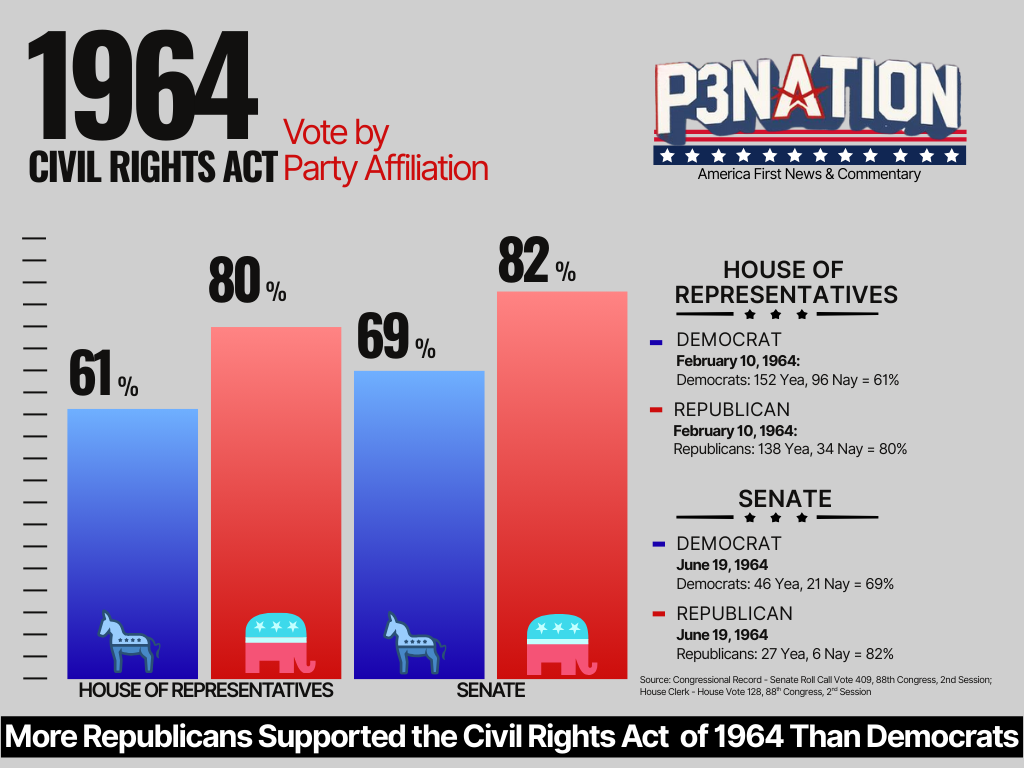
House of Representatives (Feb 10, 1964)
- Republicans: 138 Yea, 34 Nay → 80% support
- Democrats: 152 Yea, 96 Nay → 61% support
Senate Cloture (June 10, 1964) – Breaking the filibuster
- Republicans: 27 Yea, 6 Nay → 82% support
- Democrats: 44 Yea, 23 Nay → 66% support
Senate Final Passage (June 19, 1964)
- Republicans: 27 Yea, 6 Nay → 82% support
- Democrats: 46 Yea, 21 Nay → 69% support
On every critical vote, Republicans supported the bill at significantly higher rates than Democrats.
Why Republicans Delivered
- Geographic Freedom – Few Republicans represented the Deep South, freeing them from segregationist pressure.
- Party Legacy – The GOP still claimed the mantle of Lincoln and Reconstruction.
- Constitutional Safeguards – Dirksen’s amendments reassured limited-government conservatives the bill wouldn’t be a blank check for federal overreach.
The Real Legacy
The Civil Rights Act of 1964 wasn’t a one-party triumph. It was a bipartisan coalition — but it was Republicans who supplied the decisive votes, the constitutional fixes, and the leadership to overcome Democratic obstruction.
Johnson signed it, but he didn’t save it.
Republicans did.
Sources:


